Things You Did Not Know About Red Dawn
Which means at that place's lots of room for improvement this coming calendar week's remake
MGM
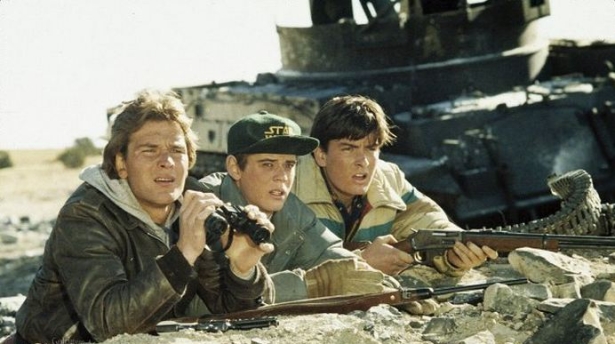
If a foreign army always invades the U.s.a., a small town in Colorado will be the least of its priorities. In that location are urban centers and missile silos to occupy, and an invasion starts from the borders inwards, non the other fashion around. Notwithstanding, dubious tactics were non a chief concern when John Milius directed Red Dawn nearly thirty years agone. The Soviet invasion classic, complete with a teeny bopper cast, is fierce, campy propaganda. It has not anile well—Red Dawn is better known for its one-liners and not its activity—just that didn't cease commencement-fourth dimension director Dan Bradley from working on a remake, which will hit theaters this coming Wednesday. This presents one of those rare instances where the update might exist better than the source cloth: Bradley has a chance to better Red Dawn by learning from the original's mistakes and by watching similarly themed non-fiction films.
Related Story
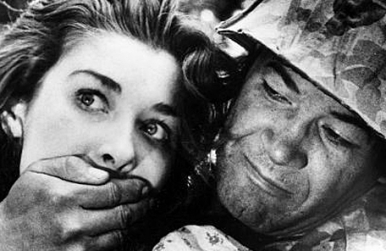
The original Red Dawn has a shrewd opening. Through terse title cards, Milius and co-screenwriter Kevin Reynolds create an alternate history of the Cold War, one where America is all that stands between peace and oblivion. This approach creates a sense of urgency, and Milius follows through with stark invasion imagery. Paratroopers land on a high-school football field, and when a history teacher greets them, he'southward shot dead. Writing in Slant, Fernando F. Croce notes that, "Earth War III might have seemed frighteningly plausible in 1984, but, every bit before long equally the invading Reds are introduced parachuting down on the varsity football field of a quaint Colorado burg, it's clear that the picture is going to exist ready squarely in the realm of hairy-chested fantasy." This fantasy is a stark contrast to Army of Shadows, a ruthlessly realistic World War 2 French resistance thriller that opens with Nazi tanks rolling past the Arc de Triomphe. Milius terrorized his audience with a familiar setting, not an iconic one, which is a sneaky way of hiding flaws. Audiences clamored to see an America that resembled their lawn, and warriors who resembled the kids next door—or the heart-throbs next door—rather than action heroes.
Simply the Ruby-red Dawn remake cannot escape the implausibility of a immature cast. Chris Hemsworth (a.grand.a. Thor) is Jed, the leader of the "Wolverines," and Nickelodeon mainstay Josh Peck plays his younger brother Matt. Even then, though, if Bradley is smart he'll give them more than interesting things to do than Milius gave to Patrick Swayze and Charlie Sheen, respectively. In the original Blood-red Dawn, the Wolverines' strategy was unproblematic: Shoot, shoot some more than, and if that didn't work, use a rocket-powered grenade. Milius never offered his guerrillas a specific objective. They battled the Reds out of blind hatred, seemingly without a goal of victory.
There is so much gunfire in Red Dawn, in fact, that it in one case held the Guinness World Tape for the well-nigh-violent pic ever fabricated (according to The National Coalition on Telly Violence, there were 134 acts of violence per hour, or two.23 per infinitesimal). Left-leaning critics took issue with the excessive gunfire in part because of Milius'south political leanings. "[A] erstwhile NRA board member, Milius is a war machine zealot, infatuated with the warrior lawmaking," writes David Plotz in Slate. "Red Dawn is really a fetish movie, an ode to guns and blood." Hopefully, in the remake, the Wolverines will at least indulge that fetish with greater purpose.
Whenever his characters were non firing their weapons, Milius showed the greenish teenagers transitioning into hardened warriors. But his endeavour at graphic symbol development was half-hearted at best. Implacable hatred drove the Wolverines, and their fervor got to the point where they abased strategy. In an unintentionally funny death scene, C. Thomas Howell screams "Wolverines!" before losing a doomed battle with a helicopter. While preserving the domestic framework, Bradley should eschew this foolhardy martyrdom accept his inspiration from foreign invasion thrillers.
The same Ground forces of Shadow gets existential about the toll of sacrifice. Director Jean-Pierre Melville, who was role of the French Resistance, stripped the characters of heroics and gave them steely conclusion instead. Ken Loach's The Wind That Shakes the Barley took a closer look at the emotional toll of guerilla fighting. Irish farmers approached warfare reluctantly and with ideology; unlike Cherry-red Dawn, in-fighting was most more than than cowardice. They battled with conscience, even if information technology meant pitting brother confronting brother. In that location is only no way Jed and Matt will achieve such an impasse—the Red Dawn remake is a cherry-red-blooded action flick before anything else—but the merely fashion to improve Red Dawn is to depict from films that handled the material with gravity and smarts.
Upon commencement glance, the biggest challenge facing a Ruddy Dawn remake is finding an appropriate enemy. With a corny synthesizer score and the threat of the Soviets, the original certainly seems like a production of its time. But Crimson Dawn was more about jingoistic patriotism than it was nearly the Common cold War. The Wolverine hatred of an "other," not the Reds specifically, is what drives the original Red Dawn. It could be near space aliens as long as a grouping of young, adept-looking kids have to the hills in a mythical Real America. It's no surprise, therefore, that the remake easily switched its enemy from Mainland china to Democratic people's republic of korea during post-product (at least they moved the activity from Colorado to Washington State, a place where an enemy could feasibly invade). In the Ruby Dawn trailer, Jed energizes the Wolverines with, "For them, this is merely some place. For us, information technology is home." The stream of pronouns preserves Milius's propaganda, but Bradley will hopefully split from the original when it's time to show how, precisely, the Wolverines avenge America.
Source: https://www.theatlantic.com/entertainment/archive/2012/11/red-dawn-wasnt-about-the-cold-war-it-was-about-shooting-people/265361/
0 Response to "Things You Did Not Know About Red Dawn"
Postar um comentário