Is the Art of War Taught at West Point
The United States Military University at West Point is 1 of the premier bookish, armed forces institutions in the globe today. The post-obit is the West Point history department's list of peak 10 archetype military novels.
On War by Carl Von Clausewitz.

Some Principles of Maritime Strategy by Julian Stafford Corbett
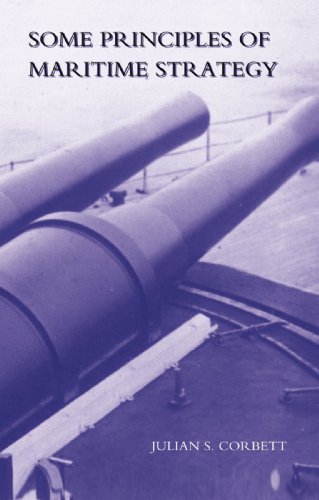
This brilliant exposition established Corbett as a classical maritime strategist whose concepts of bounding main power are plant in current U.S. maritime strategy.
History of the Art of War Within the Framework of Political History by Hans Delbruck
"Two thirds of a century later on it first appeared, this last volume of Delbruck's primal work on armed forces history has been translated into English. The work remains essential for the history of European warfare. . . . The translation reads well, although information technology occasionally reflects too closely the complicated grammar of the original German. Extensive notes and an index. . . . College, university, and big public libraries."-Choice
Command of the Air by General Giulio Douhet
In the pantheon of air ability spokesmen, Giulio Douhet holds center stage. His writings, more frequently cited than maybe actually read, appear as excerpts and aphorisms in the writings of numerous other airpower spokesmen, advocates-and critics. Though a highly controversial figure, the very controversy that surrounds him offers to u.s.a. a testimonial of the value and depth of his work, and the need for airmen today to become familiar with his idea.
The Commandant of the Marine Corps Professional Reading Listing For NCOs
The progressive development of airpower to the point where, today, it is more right to refer to aerospace ability has non outdated the notions of Douhet in the slightest In fact, in many ways, the kinds of technological capabilities that nosotros enjoy as a global airpower provider attest to the latitude of his vision. Douhet, together with Hugh "Blast" Trenchard of Corking Uk and William "Billy" Mitchell of the United States, is justly recognized equally 1 of the iii great spokesmen of the early airpower era. This reprint is offered in the spirit of continuing the dialogue that Douhet himself so perceptively began with the first edition of this book, published in 1921. Readers may well find much that they disagree inside this book, but also much that is of enduring value. The vital necessity of Douhet's central vision-that command of the air is all-important in modern warfare-has been proven throughout the history of wars in this century, from the fighting over the Somme to the air war over Kuwait and Iraq.
Roots of Strategy, Book 2 by Ardant Du Picq
Ardant du Picq's Battle Studies, Clausewitz'south Principles of War, and Jomini'south Fine art of State of war.
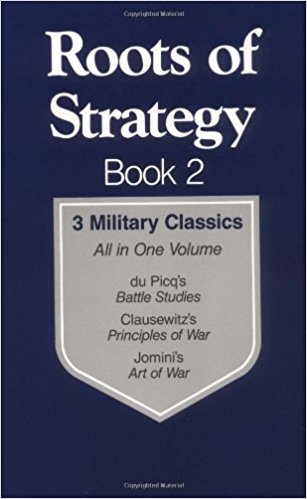
Ardant du Picq'south Battle Studies, Clausewitz'south Principles of War, and Jomini's Art of War all included in a single book.
The Fine art of War (1838) by Baron Antoine-Henri De Jomini
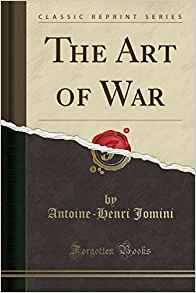
Antoine-Henri Jomini was the most celebrated writer on the Napoleonic fine art of state of war. Jomini was present at most of the most of import battles of the Napoleonic Wars. His writing, therefore, is the virtually authoritative on the subject. "The art of war, every bit generally considered, consists of five purely armed forces branches,-viz.: Strategy, Yard Tactics, Logistics, Engineering, and Tactics. A sixth and essential branch, hitherto unrecognized, might exist termed Diplomacy in its relation to War. Although this branch is more naturally and intimately connected with the profession of a statesman than with that of a soldier, it cannot be denied that, if information technology exist useless to a subordinate general, it is indispensable to every full general commanding an regular army." -Antoine-Henri Jomini
The Art of War (1521) past Niccolo Machiavelli
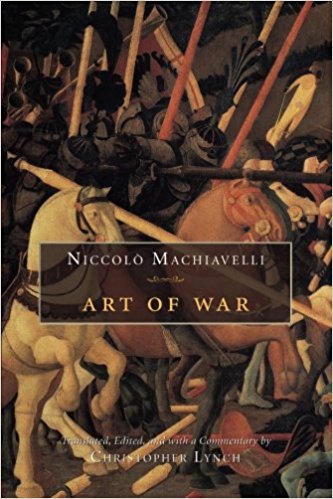
Written after 1513's "The Prince," Niccolo Machiavelli's state of war treatise, "The Art of War," is a dazzling array of state of war tactics and strategies based on the military strength of the Romans. Machiavelli wrote "The Art of War" as a dialogue between a group of immature men in the Florentine commonwealth. The main narrator, Lord Fabrizio Colonna, is the voice of knowledge and wisdom. The others ask questions about armed services tactics, and Fabrizio gives them advice on an army'southward training, deployment, and organization. Much like how the military machine communicates within itself, Machiavelli'south "The Fine art of War" is a clear, precise, and structured text. Information technology doesn't take the same wit and pessimism of Machiavelli's other works, but by choosing this style, the writer was purposefully mimicking his subject area. He too calls upon the classical tradition of dialogue to share his wisdom. While yielding to classic Roman strategies may seem outdated, Machiavelli was an expert on the subject. He spent fourteen years as the secretary to the Chancery of Florence, allowing him to oversee the day to day activities, weaponry, and logistics of the regular army. After "The Art of State of war" was released in 1521, world leaders and military tacticians slowly adopted his state of war philosophies every bit their own; the Roman strategies outlined in Machiavelli's treatise had already proved reliable for over i-1000 years, and they would continue to be applicable for many more years to come.
The Influence of Sea Power Upon History 1660-1783 by Alfred Thayer Mahan

The definite object proposed in this work is an test of the full general history of Europe and America with particular reference to the event of bounding main power upon the grade of that history. Historians generally have been unfamiliar with the weather of the sea, having equally to it neither special interest nor special noesis; and the profound determining influence of maritime forcefulness upon keen problems has consequently been disregarded. This is even more true of particular occasions than of the general tendency of sea ability. It is like shooting fish in a barrel to say in a general way, that the use and control of the sea is and has been a neat factor in the history of the earth; it is more troublesome to seek out and show its exact bearing at a particular juncture. Even so, unless this is done, the acquittance of general importance remains vague and unsubstantial; not resting, as information technology should, upon a collection of special instances in which the precise outcome has been fabricated clear, past an analysis of the conditions at the given moments.
General Mattis Reading List for Leaders
A curious exemplification of this trend to slight the bearing of maritime power upon events may exist [iv]drawn from two writers of that English nation which more than any other has owed its greatness to the bounding main. "Twice," says Arnold in his History of Rome, "Has at that place been witnessed the struggle of the highest individual genius against the resources and institutions of a great nation, and in both cases the nation was victorious. For seventeen years Hannibal strove confronting Rome, for sixteen years Napoleon strove against England; the efforts of the start concluded in Zama, those of the second in Waterloo." Sir Edward Creasy, quoting this, adds: "One point, all the same, of the similitude betwixt the ii wars has scarcely been fairly dwelt on; that is, the remarkable parallel betwixt the Roman general who finally defeated the great Carthaginian, and the English language general who gave the final deadly overthrow to the French emperor.
The Fine art of War by Dominicus Tzu.
The Art of State of war is an aboriginal Chinese military machine treatise dating from the 5th century BC. Attributed to the ancient Chinese military strategist Dominicus Tzu the text is composed of xiii chapters, each of which is devoted to ane attribute of the art of war. It is ordinarily thought of equally a definitive work on military strategy and tactics. Information technology was placed at the head of China's Seven Military Classics upon the drove's creation in 1080 by Emperor Shenzong of Song, and has long been the almost influential strategy text in East Asia. It has had an influence on Eastern and Western military thinking, business concern tactics, legal strategy, and beyond.
The Peloponnesian War by Thucydides
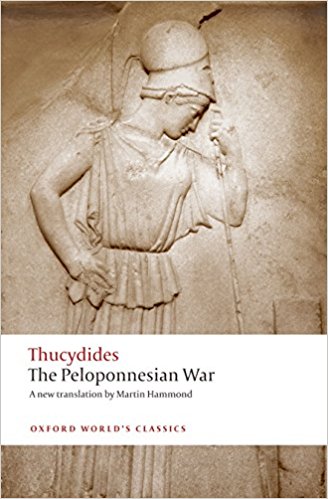
"The greatest historian that ever lived." Such was Macaulay's cess of Thucydides (c. 460-400 BC) and his history of the Peloponnesian War, the momentous struggle between Athens and Sparta that lasted for twenty-7 years from 431 to 404 BC, involved virtually the whole of the Greek world and ended in the fall of Athens. A participant in the state of war himself, Thucydides brings to his history an awesome intellect, brilliant narrative, and penetrating analysis of the nature of power, as it affects both states and individuals. Of the prose writers of the aboriginal world, Thucydides has had a more lasting influence on western thought than all simply Plato and Aristotle. This new edition combines a masterly new translation by Martin Hammond with comprehensive supporting fabric, including summaries of individual Books; textual notes; a comprehensive analytical alphabetize; an appendix on weights, measures and distances, coin, and calendars; ten maps; an upwardly-to-engagement bibliography; and an illuminating introduction by P.J. Rhodes.
Source: https://blog.refactortactical.com/blog/west-points-recommended-reading-list/
0 Response to "Is the Art of War Taught at West Point"
Postar um comentário