Question 16 Unsaved Someone Lacking in Experience and Competence in an Art or Science Is aan

Customers at Denny's Restaurant picket May 24-hour interval Demonstration-Protests. Mexico City, United mexican states, May 1, 1989
Deviance or the sociology of deviance [ane] [2] explores the actions and/or behaviors that violate social norms across formally enacted rules (east.g., crime)[3] as well as informal violations of social norms (e.thou., rejecting folkways and mores). Although deviance may have a negative connotation, the violation of social norms is not always a negative action; positive divergence exists in some situations. Although a norm is violated, a behavior can still be classified as positive or acceptable.[four]
Social norms differ throughout society and between cultures. A certain human activity or behaviour may exist viewed every bit deviant and receive sanctions or punishments within 1 society and be seen every bit a normal behaviour in some other society. Additionally, every bit a order's agreement of social norms changes over time, so too does the collective perception of deviance.[5]
Deviance is relative to the place where it was committed or to the fourth dimension the act took place. Killing another human is generally considered wrong for example, except when governments allow it during warfare or for cocky-defense. There are two types of major deviant actions: mala in se and mala prohibita.
Types [edit]
The violation of norms can be categorized as two forms, formal deviance and informal deviance. Formal deviance tin be described as a law-breaking, which violates laws in a lodge. Informal deviance are minor violations that break unwritten rules of social life. Norms that take neat moral significance are mores. Under informal deviance, a more than opposes societal taboos.[6]
Taboo is a strong social form of behavior considered deviant past a majority. To speak of it publicly is condemned, and therefore, well-nigh entirely avoided. The term "taboo" comes from the Tongan word "tapu" meaning "under prohibition", "not allowed", or "forbidden". Some forms of taboo are prohibited under law and transgressions may atomic number 82 to severe penalties. Other forms of taboo result in shame, disrespect and humiliation. Taboo is not universal but does occur in the majority of societies. Some of the examples include murder, rape, incest, or child molestation.
Howard Becker, a labeling theorist, identified four different types of deviant behavior labels which are given as:
- "Falsely accusing" an individual - others perceive the individual to exist obtaining obedient or deviant behaviors.
- "Pure deviance", others perceive the individual equally participating in deviant and rule-breaking beliefs.
- "Conforming", others perceive the individual to exist participating in the social norms that are distributed within societies.
- "Secret deviance" which is when the private is non perceived as deviant or participating in any rule-breaking behaviors.
Theories [edit]
Deviant acts can be assertions of individuality and identity, and thus every bit rebellion against group norms of the ascendant culture and in favor of a sub-culture. In a society, the behavior of an individual or a grouping determines how a deviant creates norms.[7]
Three wide sociological classes exist that describe deviant behavior, namely, structural functionalism, symbolic interaction and conflict theory.
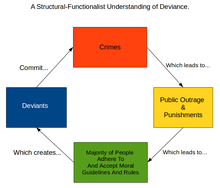
Structural-functionalist agreement of deviance
Structural-functionalism [edit]
Structural functionalists are concerned with how various factors in a lodge come together and collaborate to grade the whole. Most notable, the work of Émile Durkheim and Robert Merton have contributed to the Functionalist ideals.[8]
Durkheim's normative theory of suicide [edit]
Émile Durkheim would merits that deviance was in fact a normal and necessary part of social organisation.[3] He would country iv important functions of deviance:
- "Deviance affirms cultural values and norms. Any definition of virtue rests on an opposing thought of vice: There can exist no practiced without evil and no justice without crime."[3]
- Deviance defines moral boundaries, people learn right from wrong by defining people every bit deviant.
- A serious form of deviance forces people to come together and react in the aforementioned way against it.
- Deviance pushes society's moral boundaries which, in turn leads to social change.
When social deviance is committed, the collective conscience is offended. Durkheim (1897) describes the collective conscience equally a set of social norms by which members of a social club follow.[eight] Without the collective conscience, at that place would exist no accented morals followed in institutions or groups.
Social integration is the zipper to groups and institutions, while social regulation is the adherence to the norms and values of society. Durkheim'due south theory attributes social deviance to extremes of social integration and social regulation. He stated four dissimilar types of suicide from the relationship between social integration and social regulation:[8].
- Donating suicide occurs when one is as well socially integrated.
- Egoistic suicide occurs when one is not very socially integrated.
- Anomic suicide occurs when there is very niggling social regulation from a sense of aimlessness or despair.
- Fatalistic suicide occurs when a person experiences too much social regulation.
Merton's strain theory [edit]

Robert Yard. Merton discussed deviance in terms of goals and means as part of his strain/anomie theory. Where Durkheim states that anomie is the confounding of social norms, Merton goes further and states that anomie is the state in which social goals and the legitimate means to attain them do non correspond. He postulated that an individual's response to societal expectations and the means by which the individual pursued those goals were useful in understanding deviance. Specifically, he viewed commonage activity every bit motivated by strain, stress, or frustration in a body of individuals that arises from a disconnection betwixt the society's goals and the popularly used means to achieve those goals. Oftentimes, not-routine commonage beliefs (rioting, rebellion, etc.) is said to map onto economic explanations and causes past way of strain. These two dimensions make up one's mind the adaptation to social club according to the cultural goals, which are the order'due south perceptions well-nigh the ideal life, and to the institutionalized means, which are the legitimate means through which an individual may aspire to the cultural goals.[ix]
Merton described 5 types of deviance in terms of the acceptance or rejection of social goals and the institutionalized ways of achieving them:[3]
- Innovation is a response due to the strain generated by our culture'south emphasis on wealth and the lack of opportunities to get rich, which causes people to be "innovators" past engaging in stealing and selling drugs. Innovators accept society'south goals, but decline socially acceptable means of achieving them. (e.g.: budgetary success is gained through law-breaking). Merton claims that innovators are mostly those who accept been socialised with similar world views to conformists, but who have been denied the opportunities they need to be able to legitimately achieve guild's goals.
- Conformists have order's goals and the socially acceptable means of achieving them (due east.g.: monetary success is gained through hard work). Merton claims that conformists are mostly middle-grade people in middle course jobs who have been able to access the opportunities in social club such every bit a better education to achieve budgetary success through hard work.
- Ritualism refers to the inability to accomplish a cultural goal thus embracing the rules to the point where the people in question lose sight of their larger goals in lodge to experience respectable. Ritualists reject society'south goals, but accept guild'southward institutionalised ways. Ritualists are most commonly institute in dead-end, repetitive jobs, where they are unable to achieve society'southward goals but notwithstanding attach to guild's ways of achievement and social norms.
- Retreatism is the rejection of both cultural goals and means, letting the person in question "drib out". Retreatists reject the society's goals and the legitimate means to achieve them. Merton sees them as true deviants, as they commit acts of deviance to achieve things that do not always keep with society'south values.
- Rebellion is somewhat similar to retreatism, considering the people in question too pass up both the cultural goals and means, but they go i step further to a "counterculture" that supports other social orders that already exist (dominion breaking). Rebels refuse society'southward goals and legitimate means to accomplish them, and instead creates new goals and ways to supervene upon those of society, creating not merely new goals to achieve but besides new ways to attain these goals that other rebels volition discover acceptable.
Symbolic interaction [edit]
Symbolic interaction refers to the patterns of communication, interpretation, and adjustment betwixt individuals. Both the exact and nonverbal responses that a listener and then delivers are similarly synthetic in expectation of how the original speaker will react. The ongoing process is like the game of charades, only information technology is a full-fledged conversation.[x]
The term "symbolic interactionism" has come into employ as a characterization for a relatively distinctive approach to the study of human life and man conduct.[11] With symbolic interactionism, reality is seen every bit social, developed interaction with others. Most symbolic interactionists believe a physical reality does indeed be by an individual'south social definitions, and that social definitions exercise develop in part or relation to something "real." People thus do not answer to this reality straight, merely rather to the social agreement of reality. Humans therefore exist in three realities: a physical objective reality, a social reality, and a unique. A unique is described as a tertiary reality created out of the social reality, a private interpretation of the reality that is shown to the person by others.[12] Both individuals and order cannot be separated far from each other for two reasons. One, being that both are created through social interaction, and two, one cannot exist understood in terms without the other. Behavior is non divers by forces from the surroundings such every bit drives, or instincts, but rather by a reflective, socially understood significant of both the internal and external incentives that are currently presented.[13]
Herbert Blumer (1969) set out iii bones bounds of the perspective:[11]
- "Humans human activity toward things on the basis of the meanings they ascribe to those things;"
- "The pregnant of such things is derived from, or arises out of, the social interaction that 1 has with others and the order;" and
- "These meanings are handled in, and modified through, an interpretative process used past the person in dealing with the things he/she encounters;"
Sutherland's differential association [edit]
In his differential clan theory, Edwin Sutherland posited that criminals larn criminal and deviant behaviors and that deviance is non inherently a function of a detail individual's nature. When an individual'southward significant others engage in deviant and/or criminal behavior, criminal behavior volition be learned as a consequence to this exposure.[14] He argues that criminal beliefs is learned in the same fashion that all other behaviors are learned, meaning that the acquisition of criminal cognition is non unique compared to the learning of other behaviors.
Sutherland outlined some very basic points in his theory, including the thought that the learning comes from the interactions betwixt individuals and groups, using communication of symbols and ideas. When the symbols and ideas about divergence are much more favorable than unfavorable, the individual tends to take a favorable view upon deviance and will resort to more of these behaviors.
Criminal behavior (motivations and technical cognition), every bit with any other sort of behavior, is learned. One example of this would exist gang action in inner metropolis communities. Sutherland would feel that because a sure individual's primary influential peers are in a gang environment, it is through interaction with them that i may become involved in crime.[14]
Neutralization theory [edit]
Gresham Sykes and David Matza's neutralization theory explains how deviants justify their deviant behaviors by providing alternative definitions of their actions and by providing explanations, to themselves and others, for the lack of guilt for actions in item situations.
There are five types of neutralization:[15]
- Denial of responsibleness: the deviant believes s/he was helplessly propelled into the deviance, and that nether the same circumstances, any other person would resort to like actions;
- Denial of injury: the deviant believes that the action caused no damage to other individuals or to the guild, and thus the deviance is not morally wrong;
- Deprival of the victim: the deviant believes that individuals on the receiving end of the deviance were deserving of the results due to the victim's lack of virtue or morals;
- Condemnation of the condemners: the deviant believes enforcement figures or victims have the tendency to be every bit deviant or otherwise corrupt, and every bit a outcome, are hypocrites to stand up against; and
- Appeal to higher loyalties: the deviant believes that there are loyalties and values that go beyond the confines of the police force; morality, friendships, income, or traditions may exist more important to the deviant than legal boundaries.
Labeling theory [edit]
Frank Tannenbaum and Howard Southward. Becker created and developed the labeling theory, which is a cadre facet of symbolic interactionism, and frequently referred to as Tannenbaum's "dramatization of evil." Becker believed that "social groups create deviance by making the rules whose infraction constitutes deviance".
Labeling is a process of social reaction by the "social audience," wherein people stereotype others, judging and accordingly defining (labeling) someone'due south beliefs as deviant or otherwise. It has been characterized as the "invention, selection, manipulation of beliefs which define conduct in a negative way and the selection of people into these categories."[16]
Every bit such, labeling theory suggests that deviance is acquired by the deviant's being labeled as morally inferior, the deviant's internalizing the characterization and finally the deviant's acting according to that specific label (i.due east., an individual labelled as "deviant" will deed accordingly). As fourth dimension goes by, the "deviant" takes on traits that constitute deviance past committing such deviations equally conform to the label (so the audience has the power to not label them and have the ability to terminate the deviance before it ever occurs by not labeling them). Individual and societal preoccupation with the characterization, in other words, leads the deviant individual to follow a self-fulfilling prophecy of abidance to the ascribed label.[3]
This theory, while very much symbolically interactionist, likewise has elements of disharmonize theory, as the dominant grouping has the power to decide what is deviant and adequate, and enjoys the ability behind the labeling process. An instance of this is a prison house organization that labels people convicted of theft, and because of this they start to view themselves every bit past definition thieves, incapable of changing. "From this point of view," Howard Due south. Becker writes:[17]
Deviance is not a quality of the human activity the person commits, but rather a outcome of the application by others of rules and sanctions to an "offender". The deviant is one to whom the characterization has successfully been applied; deviant beliefs is behavior that people so label.[ page needed ]
In other words, "behavior merely becomes deviant or criminal if defined and interfered as such past specific people in [a] specific situation."[18] It is of import to annotation the salient fact that lodge is not always right in its labeling, often falsely identifying and misrepresenting people equally deviants, or attributing to them characteristics which they exercise not have. In legal terms, people are often wrongly accused, however many of them must alive with the ensuant stigma (or conviction) for the rest of their lives.
On a similar note, society oftentimes employs double standards, with some sectors of society enjoying favouritism. Certain behaviors in i group are seen to exist perfectly acceptable, or can be hands overlooked, but in another are seen, by the same audiences, as beastly.
The medicalization of deviance, the transformation of moral and legal deviance into a medical condition, is an important shift that has transformed the mode lodge views deviance.[3] : 204 The labelling theory helps to explain this shift, every bit behaviour that used to be judged morally are now being transformed into an objective clinical diagnosis. For example, people with drug addictions are considered "sick" instead of "bad."[3] : 204
Primary and secondary departure [edit]
Edwin Lemert developed the idea of chief and secondary deviation every bit a style to explain the process of labeling. Principal deviance is any full general deviance earlier the deviant is labeled equally such in a detail way. Secondary deviance is any action that takes identify after primary deviance equally a reaction to the institutional identification of the person as a deviant.[3]
When an actor commits a crime (chief deviance), however mild, the institution will bring social penalties down on the actor. Still, penalization does non necessarily stop crime, so the actor might commit the aforementioned primary deviance again, bringing even harsher reactions from the institutions. At this point, the actor will start to resent the establishment, while the institution brings harsher and harsher repression. Somewhen, the whole customs volition stigmatize the actor as a deviant and the actor volition non be able to tolerate this, but will ultimately have his or her office as a criminal, and will commit criminal acts that fit the role of a criminal.
Principal and secondary deviation is what causes people to go harder criminals. Primary deviance is the time when the person is labeled deviant through confession or reporting. Secondary deviance is deviance before and after the principal deviance. Retrospective labeling happens when the deviant recognizes his acts equally deviant afterward the main deviance, while prospective labeling is when the deviant recognizes futurity acts equally deviant. The steps to becoming a criminal are:
- Main difference;
- Social penalties;
- Secondary divergence;
- Stronger penalties;
- Further deviation with resentment and hostility towards punishers;
- Community stigmatizes the deviant as a criminal;
- Tolerance threshold passed;
- Strengthening of deviant bear because of stigmatizing penalties; and finally,
- Acceptance every bit role of deviant or criminal actor.
Cleaved windows theory [edit]
Broken windows theory states that an increase in small-scale crimes such as graffiti, would eventually pb to and encourage an increment in larger transgressions. This suggests that greater policing on minor forms of deviance would lead to a decrease in major crimes. The theory has been tested in a variety of settings including New York City in the 90s. Compared to the country'due south average at the fourth dimension, violent law-breaking rates fell 28 percent as a result of the campaign. Critics of the theory question the straight causality of the policing and statistical changes that occurred.[19]
Control theory [edit]
Control theory advances the proposition that weak bonds between the individual and society gratuitous people to deviate. By dissimilarity, strong bonds make deviance costly. This theory asks why people refrain from deviant or criminal behavior, instead of why people commit deviant or criminal behavior, co-ordinate to Travis Hirschi. The control theory developed when norms emerge to deter deviant beliefs. Without this "command", deviant behavior would happen more than often. This leads to conformity and groups. People will conform to a group when they believe they have more than to gain from conformity than by deviance. If a strong bond is achieved at that place volition be less adventure of deviance than if a weak bond has occurred. Hirschi argued a person follows the norms because they have a bond to order. The bond consists of four positively correlated factors: opportunity, attachment, belief, and involvement.[3] : 204 When any of these bonds are weakened or broken one is more likely to act in defiance. Michael Gottfredson and Travis Hirschi in 1990 founded their Self-Command Theory. Information technology stated that acts of strength and fraud are undertaken in the pursuit of self-involvement and cocky-control. A deviant act is based on a criminals ain cocky-control of themselves.
Containment theory is considered past researchers such every bit Walter C. Reckless to exist part of the control theory because it also revolves effectually the thoughts that finish individuals from engaging in crime. Reckless studied the unfinished approaches meant to explicate the reasoning backside delinquency and crime. He recognized that societal disorganization is included in the study of malversation and crime nether social deviance, leading him to merits that the majority of those who live in unstable areas tend non to have criminal tendencies in comparison those who live in eye-class areas. This claim opens up more possible approaches to social disorganization, and proves that the already implemented theories are in demand or a deeper connection to further explore ideas of crime and delinquency. These observations brought Reckless to enquire questions such as, "Why do some persons break through the tottering (social) controls and others do not? Why do rare cases in well-integrated society pause through the lines of stiff controls?" Reckless asserted that the intercommunication between self-command and social controls are partly responsible for the evolution of delinquent thoughts. Social disorganization was not related to a item surround, but instead was involved in the deterioration of an individuals social controls. The containment theory is the idea that anybody possesses mental and social safeguards which protect the individual from committing acts of deviancy. Containment depends on the individuals ability to separate inner and outer controls for normative behavior.[20]
More gimmicky control theorists such as Robert Crutchfield take the theory into a new light, suggesting labor market experiences not only touch the attitudes and the "stakes" of individual workers, but can likewise affect the evolution of their children'southward views toward conformity and cause involvement in delinquency. This is an ongoing study every bit he has found a significant relationship between parental labor market place interest and children's delinquency, merely has non empirically demonstrated the mediating office of parents' or children'due south attitude.[ citation needed ] In a study conducted past Tim Wadsworth, the relationship between parent's employment and children'due south delinquency, which was previously suggested by Crutchfield (1993), was shown empirically for the first time. The findings from this study supported the idea that the human relationship between socioeconomic status and delinquency might be improve understood if the quality of employment and its part as an informal social control is closely examined.[21]
Disharmonize theory [edit]
In sociology, conflict theory states that order or an system functions so that each individual participant and its groups struggle to maximize their benefits, which inevitably contributes to social change such every bit political changes and revolutions. Deviant behaviors are deportment that practice non go forth with the social institutions equally what cause deviance. The establishment'southward ability to change norms, wealth or condition comes into conflict with the individual. The legal rights of poor folks might exist ignored, middle class are as well accept; they side with the elites rather than the poor, thinking they might rise to the top by supporting the status quo. Conflict theory is based upon the view that the fundamental causes of crime are the social and economical forces operating inside gild. However, it explains white-collar criminal offence less well.
This theory likewise states that the powerful ascertain crime. This raises the question: for whom is this theory functional? In this theory, laws are instruments of oppression: tough on the powerless and less tough on the powerful.
Karl Marx [edit]
Marx did non write about deviant behavior but he wrote most alienation amongst the proletariat—likewise every bit between the proletariat and the finished product—which causes conflict, and thus deviant behavior.
Many Marxist theorists take employed the theory of the backer state in their arguments. For example, Steven Spitzer utilized the theory of bourgeois control over social junk and social dynamite; and George Rusche was known to nowadays analysis of different punishments correlated to the social capacity and infrastructure for labor. He theorized that throughout history, when more than labor is needed, the severity of punishments decreases and the tolerance for deviant behavior increases. Jock Young, another Marxist writer, presented the thought that the modern world did not approve of diversity, merely was not agape of social disharmonize. The belatedly modern globe, nonetheless, is very tolerant of diversity.[3] Still, it is extremely afraid of social conflicts, which is an explanation given for the political correctness motion. The late modern society easily accepts difference, but it labels those that it does not want as deviant and relentlessly punishes and persecutes.
Michel Foucault [edit]
Michel Foucault believed that torture had been phased out from modern society due to the dispersion of power; there was no need any more for the wrath of the land on a deviant individual. Rather, the modern state receives praise for its fairness and dispersion of power which, instead of controlling each individual, controls the mass.
He also theorized that institutions command people through the use of bailiwick. For case, the modern prison (more specifically the panopticon) is a template for these institutions considering information technology controls its inmates by the perfect utilise of discipline.
Foucault theorizes that, in a sense, the postmodern society is characterized by the lack of gratuitous will on the role of individuals. Institutions of knowledge, norms, and values, are merely in identify to categorize and command humans.
Biological theories of deviance [edit]
Praveen Attri claims genetic reasons to be largely responsible for social deviance. The Italian school of criminology contends that biological factors may contribute to offense and deviance. Cesare Lombroso was amid the beginning to research and develop the Theory of Biological Deviance which states that some people are genetically predisposed to criminal beliefs. He believed that criminals were a product of before genetic forms. The main influence of his research was Charles Darwin and his Theory of Evolution. Lombroso theorized that people were born criminals or in other words, less evolved humans who were biologically more related to our more primitive and animalistic urges. From his research, Lombroso took Darwin's Theory and looked at primitive times himself in regards to deviant behaviors. He plant that the skeletons that he studied mostly had depression foreheads and protruding jaws. These characteristics resembled primitive beings such as Homo Neanderthalensis. He stated that piddling could be done to cure built-in criminals because their characteristics were biologically inherited. Over time, about of his research was disproved. His research was refuted by Pearson and Charles Goring. They discovered that Lombroso had not researched plenty skeletons to make his research thorough enough. When Pearson and Goring researched skeletons on their own they tested many more and found that the os structure had no relevance in deviant behavior. The statistical study that Charles Goring published on this research is called "The English Captive".
Other theories [edit]
The classical school of criminology comes from the works of Cesare Beccaria and Jeremy Bentham. Beccaria assumed a utilitarian view of order along with a social contract theory of the country. He argued that the role of the state was to maximize the greatest possible utility to the maximum number of people and to minimize those actions that damage the social club. He argued that deviants commit deviant acts (which are harmful to the society) because of the utility it gives to the private individual. If the land were to lucifer the pain of punishments with the utility of various deviant behaviors, the deviant would no longer have any incentive to commit deviant acts. (Notation that Beccaria argued for just punishment; as raising the severity of punishments without regard to logical measurement of utility would cause increasing degrees of social damage once it reached a certain point.)
The criminal justice organization [edit]
There are three sections of the criminal justice system that office to enforce formal deviance:[5]
- Police: The police maintain public order by enforcing the police force. Police use personal discretion in deciding whether and how to handle a situation. Research suggests that police are more likely to make an arrest if the offence is serious, if bystanders are nowadays, or if the doubtable is of a visible minority.[3]
- Courts: Courts rely on an adversarial process in which attorneys-one representing the defendant and one representing the Crown-present their cases in the presence of a judge who monitors legal procedures. In practise, courts resolve about cases through plea bargaining. Though efficient, this method puts less powerful people at a disadvantage.[3]
- Corrections system: Community-based corrections include probation and parole.[five] These programs lower the cost of supervising people bedevilled of crimes and reduce prison overcrowding merely have not been shown to reduce recidivism.[3]
In that location are four jurisdictions for penalisation (retribution, deterrence, rehabilitation, societal protection),[3] which fall under one of two forms of justice that an offender will face:[8]
- Punitive justice (retribution & deterrence): This form of justice defines boundaries of adequate behaviors, whereby an individual suffers the consequences of committing a criminal offense and in which pain or suffering inflicted on the individual is hidden from the public.
- Rehabilitative justice (rehabilitation & societal protection): This grade of justice focuses on specific circumstances, whereby individuals are meant to be fixed.
See also [edit]
- Aberration
- Hating beliefs
- Deviant Behavior
- Libertine
- Nonconformity
- Personality disorders
- Antisocial personality disorder
- Political abuse of psychiatry
- Positive deviance
- Psychopathy
- Role engulfment
- Rudeness
- Sin
- Social disorganization theory
- Sociopathy
- Workplace assailment
- Workplace deviance
- Victimology
Notes [edit]
- ^ Erikson, Kai T. (1962). "Notes on the Sociology of Deviance". Social Problems. 9 (iv): 307–314. doi:ten.2307/798544. ISSN 0037-7791.
- ^ Goode, Erich (2015), "The Sociology of Deviance", The Handbook of Deviance, John Wiley & Sons, Ltd, pp. one–29, doi:10.1002/9781118701386.ch1, ISBN978-1-118-70138-6 , retrieved 2021-xi-05
- ^ a b c d e f chiliad h i j yard l m north Macionis, John; Gerber, Linda (2010). Sociology (7th Canadian ed.). Toronto: Pearson. ISBN978-0-13-511927-three.
- ^ Heckert, Alex (2002). "A new typology of deviance: Integrating normative and reactivist definitions of deviance". Deviant Behavior. 23 (five): 449–79. doi:10.1080/016396202320265319. S2CID 144506509.
- ^ a b c "Introduction to Folklore 2e". OpenStax CNX (Open source textbook). Rice Academy. Deviance and Control. Retrieved 2019-02-28 .
- ^ "Folklore". Social Scientific discipline LibreTexts. Open Education Resource LibreTexts Project. 2018-07-thirty. 7.1B: Norms and Sanctions. Retrieved 2019-04-22 .
- ^ "7.1E: The Functions of Deviance". Social Sci LibreTexts. 2018-07-thirty. Retrieved 2019-04-22 .
- ^ a b c d Conley, Dalton (2017) [1969]. You May Ask Yourself: An Introduction to Thinking Like a Sociologist (fifth ed.). New York: W. W. Norton. ISBN9780393602388. OCLC 964624559.
- ^ Paternoster, R.; Mazerolle, P. (1994). "General strain theory and delinquency: A replication and extension". Journal of Research in Offense and Malversation. 31 (3): 235. doi:10.1177/0022427894031003001. S2CID 145283538.
- ^ Griffin, Em (2012). A Starting time Look at Communication Theory . New York: McGraw-Hill. p. 54. ISBN978-0-07-353430-five.
- ^ a b Blumer, Herbert (1969). Symbolic interactionism; perspective and method. Englewood Cliffs, N.J.: Prentice-Hall. ISBN978-0-13-879924-3. OCLC 18071.
- ^ J. M. Charon. 2007. Symbolic Interactionism: An Introduction, An Interpretation, Integration. Upper Saddle River, NJ: Pearson Prentice Hall.
- ^ Meltzer, B. N., J. West. Petras, and 50. T. Reynolds. 1975. Symbolic Interactionism: Genesis, Varieties, and Criticism. Boston: Routledge & Kegan Paul.
- ^ a b Botterweck, Michael C., et al. (eds.). 2011. Everyday Sociology. Elmhurst, IL: Starpoint Press. p 152.
- ^ Mitchell, Jim; Clump, Richard A. (1983). "Types of neutralization and delinquency". Journal of Youth and Adolescence. 12 (4): 307–18. doi:ten.1007/BF02088729. PMID 24306310. S2CID 206811362.
- ^ Jensen, Gary F. 2007. The Path of the Devil: Early Mod Witch Hunts. Lanham, Medico: Rowman & Littlefield. p. 88.
- ^ Becker, Howard S. 1963. Outsiders: Studies in the Sociology of Deviance. New York: The Costless Press. ISBN 978-0-684-83635-five.
- ^ Thomson, Doug. 2004. Crime and Deviance. p. 12.
- ^ Greene, Jim (2018). Broken Windows Theory. Salem Press Encyclopedia.
- ^ Flexon, Jamie L. (2010). "Reckless, Walter C.: Containment Theory". In Cullen, Francis T.; Wilcox, Pamela (eds.). Encyclopedia of Criminological Theory. Thousand Oaks, Calif.: SAGE Publications. pp. 777–82. ISBN9781412959186.
- ^ Wadsworth, T. (2000). "Labor markets, delinquency, and social control theory: An empirical assessment of the mediating process". Social Forces. 78 (three): 1041–66. doi:10.1093/sf/78.3.1041.
Farther reading [edit]
- Clinard, K. B., and R. F. Meier. 1968. Sociology of Deviant Behavior.
- Dinitz, Simon, Russell R. Dynes, and Alfred C. Clarke. 1975. Deviance: Studies in Definition, Direction, and Treatment.
- Douglas, J. D., and F. C. Waksler. 1982. The Folklore of Deviance: An Introduction. Boston: Little, Brown & Co.
- MacNamara, Donal E. J., and Andrew Karmen. 1983. DEVIANTS: Victims or Victimizers? Beverly Hills, Calif.: Sage.
- Pratt, Travis. n.d. "Reconsidering Gottfredson and Hirschi's General Theory of Crime: Linking the Micro- and Macro-level Sources of Self-control and Criminal Behavior Over the Life-course."
- Bartel, Phil. 2012. "Deviance." Social Command and Responses to Variant Behaviour (module). Vancouver Customs Network. Spider web. Accessed 7 April 2020.
- "Types of Deviance." Criminal Justice. Acadia University. Archived from the original on 17 Oct ten. Retrieved on 23 February. 2012.
- "Research at CSC ." Correctional Service of Canada. Government of Canada. Spider web. Retrieved on 23 Feb 2012.
- Macionis, John, and Linda Gerber. 2010. "Emile Durkheim"s Basic Insight" Sociology (seventh ed.).
- Macionis, John, and Linda Gerber. 2010. "The Criminal Justice System" Sociology (seventh ed.).
External links [edit]
Source: https://en.wikipedia.org/wiki/Deviance_(sociology)
0 Response to "Question 16 Unsaved Someone Lacking in Experience and Competence in an Art or Science Is aan"
Postar um comentário